
Top cryptocurrency
The sudden drop in value caused backlash from Welch’s fans, with one person calling her out online as they wrote: “I am a huge fan of Hawk Tuah but you took my life savings https://funanimaux.com/zombie-slot-machines/. I purchased your coin $Hawk that you were so excited about with my life savings and children’s college education fund as well.”
In the lawsuit filed Thursday against the $HAWK creators in New York District Court, investors accused overHere Ltd, its founder Clinton So, social media influencer Alez Larson Schultz and the Tuah The Moon Foundation of fraudulently selling Welch’s celebrity memecoin, per Hollywood Reporter.
Emily Brown is UNILAD Editorial Lead at LADbible Group. She first began delivering news when she was just 11 years old – with a paper route – before graduating with a BA Hons in English Language in the Media from Lancaster University. Emily joined UNILAD in 2018 to cover breaking news, trending stories and longer form features. She went on to become Community Desk Lead, commissioning and writing human interest stories from across the globe, before moving to the role of Editorial Lead. Emily now works alongside the UNILAD Editor to ensure the page delivers accurate, interesting and high quality content.
Welch, who was not named as a defendant in the lawsuit, issued a statement on X, formerly Twitter Friday that read, “I take this situation extremely seriously and want to address my fans, the investors who have been affected, and the broader community.”
Welch brought an abrupt end to the X Spaces by saying “Anyhoo, I’m gonna go to bed.” This was the start of more than two weeks of silence, prompting the meme that she had fallen into a very deep sleep.
What is cryptocurrency
Mining is how new units of cryptocurrency are released into the world, generally in exchange for validating transactions. While it’s theoretically possible for the average person to mine cryptocurrency, it’s increasingly difficult in proof-of-work systems, like Bitcoin.
Because it is impossible to set up a central authority or bank to manage blockchains, crypto transactions are validated by nodes (computers connected to a blockchain). So the question is: How do these networks ensure that node operators are willing to partake in the validation process?
Mining is how new units of cryptocurrency are released into the world, generally in exchange for validating transactions. While it’s theoretically possible for the average person to mine cryptocurrency, it’s increasingly difficult in proof-of-work systems, like Bitcoin.
Because it is impossible to set up a central authority or bank to manage blockchains, crypto transactions are validated by nodes (computers connected to a blockchain). So the question is: How do these networks ensure that node operators are willing to partake in the validation process?
Some platforms will also accept ACH transfers and wire transfers. The accepted payment methods and time taken for deposits or withdrawals differ per platform. Equally, the time taken for deposits to clear varies by payment method.
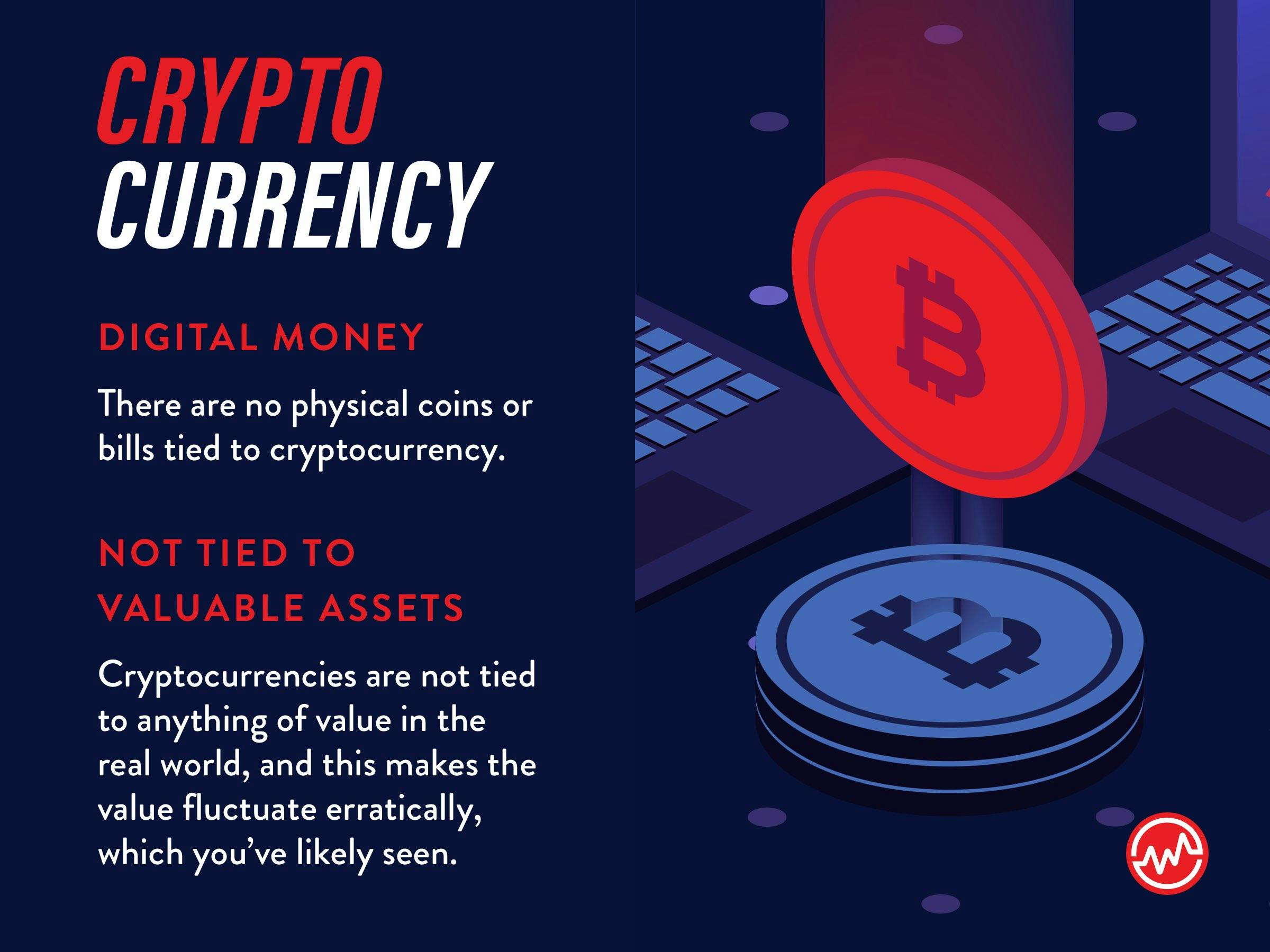
Cryptocurrency is a digital payment system that doesn’t rely on banks to verify transactions. It’s a peer-to-peer system that can enable anyone anywhere to send and receive payments. Instead of being physical money carried around and exchanged in the real world, cryptocurrency payments exist purely as digital entries to an online database describing specific transactions. When you transfer cryptocurrency funds, the transactions are recorded in a public ledger. Cryptocurrency is stored in digital wallets.
Cryptocurrency
A 2020 EU report found that users had lost crypto-assets worth hundreds of millions of US dollars in security breaches at exchanges and storage providers. Between 2011 and 2019, reported breaches ranged from four to twelve a year. In 2019, more than a billion dollars worth of cryptoassets was reported stolen. Stolen assets “typically find their way to illegal markets and are used to fund further criminal activity”.
Bitcoin (BTC) is the first cryptocurrency known for its decentralized nature and limited supply of 21 million coins. Think of a limited supply like this: with US dollars, the government can print more whenever it wants. This can sometimes lead to too many dollars in circulation, raising prices (inflation).
Transactions are put together in groups called blocks. The blocks are organized in a chronological sequence called the blockchain. Blocks are added to the chain using a mathematical process that makes it extremely difficult for an individual user to hijack the blockchain. The blockchain technology that underpins Bitcoin has attracted considerable attention, even from skeptics of Bitcoin, as a basis for allowing trustworthy recordkeeping and commerce without a central authority. Blockchain technology is also critical to NFTs (non-fungible tokens), which are often paid for with cryptocurrency.

A 2020 EU report found that users had lost crypto-assets worth hundreds of millions of US dollars in security breaches at exchanges and storage providers. Between 2011 and 2019, reported breaches ranged from four to twelve a year. In 2019, more than a billion dollars worth of cryptoassets was reported stolen. Stolen assets “typically find their way to illegal markets and are used to fund further criminal activity”.
Bitcoin (BTC) is the first cryptocurrency known for its decentralized nature and limited supply of 21 million coins. Think of a limited supply like this: with US dollars, the government can print more whenever it wants. This can sometimes lead to too many dollars in circulation, raising prices (inflation).
Transactions are put together in groups called blocks. The blocks are organized in a chronological sequence called the blockchain. Blocks are added to the chain using a mathematical process that makes it extremely difficult for an individual user to hijack the blockchain. The blockchain technology that underpins Bitcoin has attracted considerable attention, even from skeptics of Bitcoin, as a basis for allowing trustworthy recordkeeping and commerce without a central authority. Blockchain technology is also critical to NFTs (non-fungible tokens), which are often paid for with cryptocurrency.